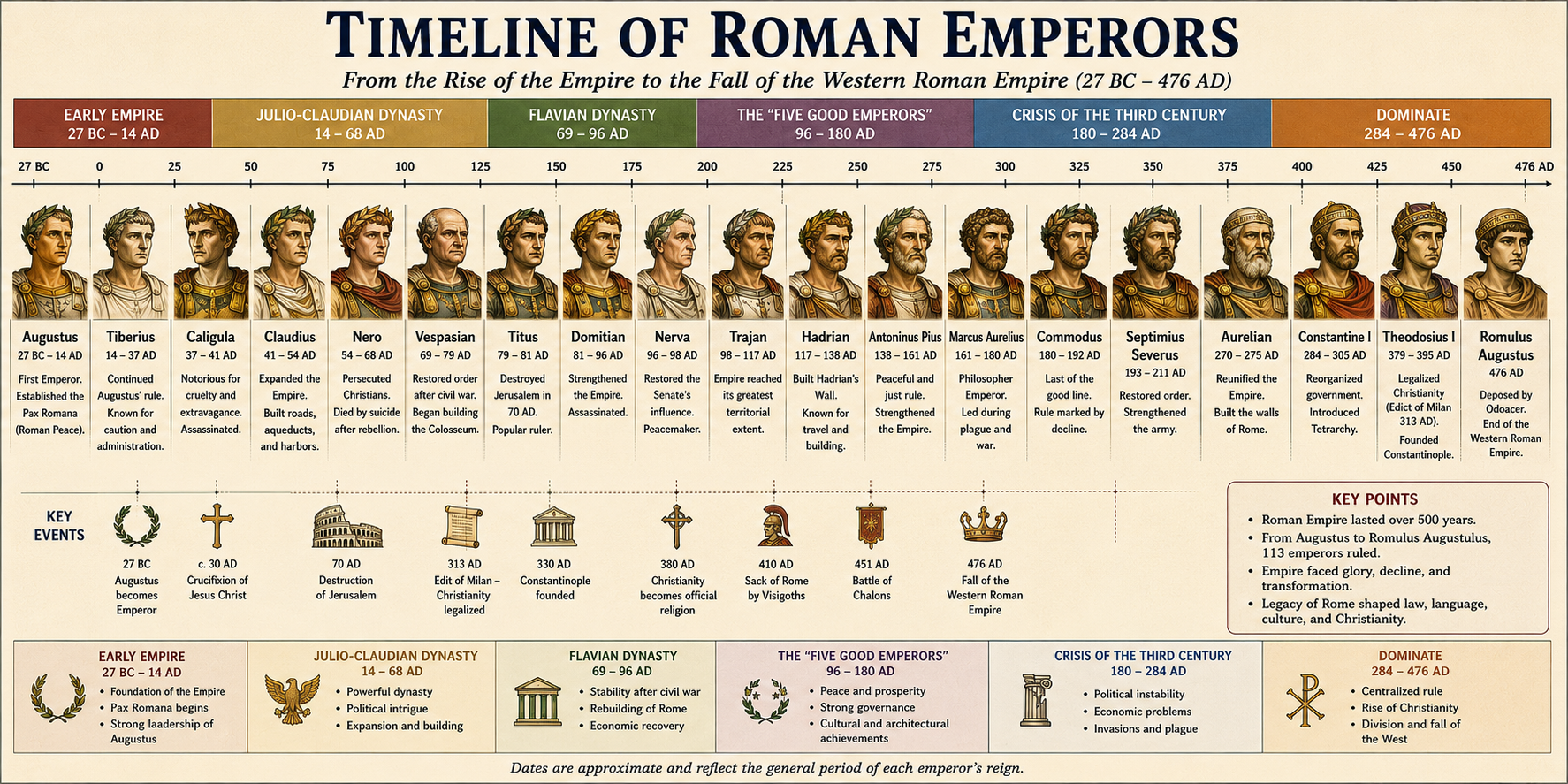
Augustus
Founder and first emperor of the Roman Empire, Augustus established the Principate and presided over the beginning of the Pax Romana. Jesus was born during his reign.
Augustus' successor, Tiberius was an experienced soldier and capable administrator whose reign became increasingly reclusive. Jesus was crucified under Pontius Pilate during his rule.
Caligula ruled only four years and became notorious in ancient accounts for increasingly autocratic and extravagant behavior. He was assassinated by members of the Praetorian Guard.
Claudius proved an able administrator, expanded Roman rule into Britain, and strengthened the imperial bureaucracy. Acts records his expulsion of Jews from Rome, affecting Aquila and Priscilla.
The last Julio-Claudian emperor, Nero became notorious for autocratic rule and for the brutal persecution of Christians after the Great Fire of Rome in AD 64.
Galba succeeded Nero in AD 68 and became the first emperor of the Year of the Four Emperors. His unpopular policies quickly cost him military support, and he was murdered.
Otho seized power after the murder of Galba but ruled for only three months. Defeated by the forces of Vitellius at Bedriacum, he committed suicide rather than prolong the civil war.
Vitellius became the third emperor of AD 69 after defeating Otho. His brief rule ended when the eastern legions backed Vespasian and Flavian forces captured Rome.
Vespasian restored stability after the civil wars of AD 69 and founded the Flavian dynasty. He had earlier commanded Roman forces against the Jewish revolt in Judea.
Titus completed the Roman conquest of Jerusalem in AD 70, destroying the city and Second Temple. He later succeeded his father Vespasian and ruled as emperor from AD 79 to 81.
The last Flavian emperor, Domitian strengthened imperial administration but ruled in an increasingly authoritarian manner. Ancient Christian sources associate his later reign with persecution.
Nerva succeeded Domitian and began the Nerva-Antonine dynasty. His brief reign helped stabilize Rome and established the practice of adopting a capable successor, beginning with Trajan.