Trajan
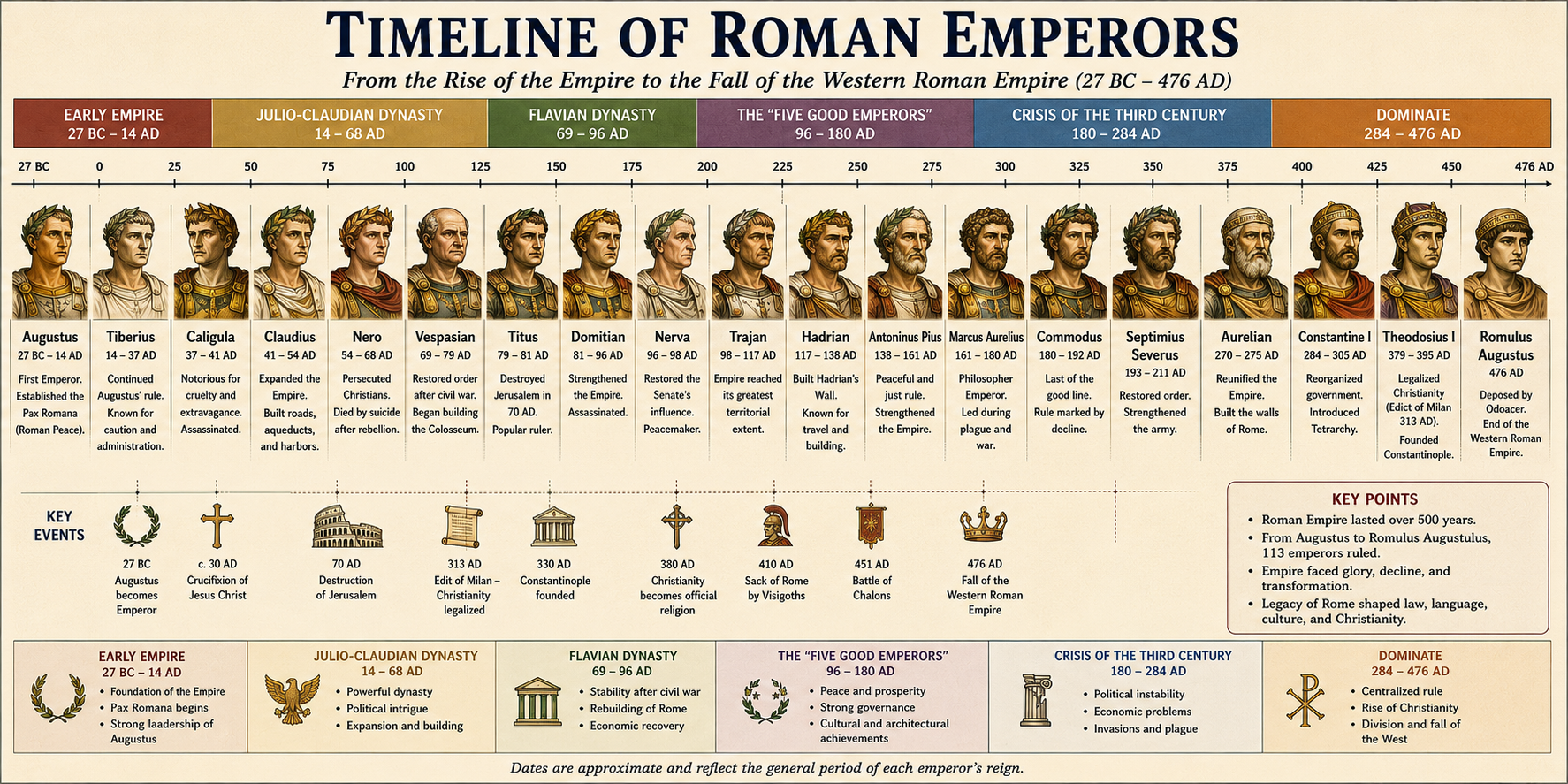
Trajan expanded Rome to its greatest territorial extent and became one of its most celebrated soldier-emperors. His correspondence with Pliny records Roman policy toward accused Christians.
Hadrian abandoned some of Trajan's conquests and concentrated on defensible frontiers and imperial consolidation. Late in his reign he suppressed the Bar Kokhba revolt in Judea.
Antoninus Pius presided over a long and generally peaceful reign marked by effective administration and financial stability. Christian tradition remembers his period as comparatively peaceful.
Marcus Aurelius was both Roman emperor and an influential Stoic philosopher. His reign faced war and plague, while several significant episodes of local persecution of Christians occurred.
Lucius Verus ruled jointly with Marcus Aurelius from AD 161 to 169, the first sustained co-emperorship in Roman history. His reign was dominated by war with Parthia.
Commodus ruled jointly with Marcus Aurelius before becoming sole emperor in AD 180. His increasingly arbitrary rule and self-glorification ended with his assassination in AD 192.
Pertinax succeeded Commodus but ruled for only 87 days in AD 193. His efforts to restore discipline alienated the Praetorian Guard, whose soldiers murdered him in the palace.
Didius Julianus gained the throne after the Praetorian Guard effectively auctioned the imperial office following Pertinax's murder. His rule lasted only 66 days before Septimius Severus prevailed.
Septimius Severus emerged victorious from the civil wars of AD 193 and founded the Severan dynasty. His reign strengthened the army and expanded Roman power on several frontiers.
Caracalla ruled first with his family and later alone after arranging the murder of his brother Geta. His Constitutio Antoniniana extended Roman citizenship to nearly all free men in the empire.
Geta became co-emperor with his father Septimius Severus and brother Caracalla. After Severus died, rivalry between the brothers ended when Geta was murdered on Caracalla's orders.
Macrinus, formerly Caracalla's praetorian prefect, became the first Roman emperor from the equestrian rather than senatorial class. Military revolt ended his reign after little more than a year.