Back

Wiki Details
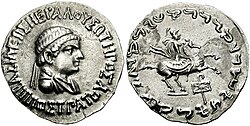 The Indo-Greek Kingdom, also known as the Yavana Kingdom, were Hellenistic-era Greek kingdoms covering most of modern-day Pakistan and some eastern parts of Afghanistan.
The term "Indo-Greek Kingdom" loosely describes a number of various Hellenistic states, ruling from regional capitals like Taxila, Sagala, Pushkalavati, and Bagram. Other centers are only hinted at; e.g. Ptolemy's Geographia and the nomenclature of later kings suggest that a certain Theophilus in the south of the Indo-Greek sphere of influence may also have had a royal seat there at one time.
The kingdom was founded when the Graeco-Bactrian king Demetrius I of Bactria invaded India from Bactria in about 200 BC. The Greeks to the east of the Seleucid Empire were eventually divided to the Graeco-Bactrian Kingdom and the Indo-Greek Kingdoms in the North Western Indian Subcontinent.
During the two centuries of their rule, the Indo-Greek kings combined the Greek and Indian languages and symbols, as seen on their coins, and blended Greek and Indian ideas, as seen in the archaeological remains. The diffusion of Indo-Greek culture had consequences which are still felt today, particularly through the influence of Greco-Buddhist art. The ethnicity of the Indo-Greek may also have been hybrid to some degree. Euthydemus I was, according to Polybius, a Magnesian Greek. His son, Demetrius I, founder of the Indo-Greek kingdom, was therefore of Greek ethnicity at least by his father. A marriage treaty was arranged for the same Demetrius with a daughter of the Seleucid ruler Antiochus III. The ethnicity of later Indo-Greek rulers is sometimes less clear. For example, Artemidoros (80 BC) was supposed to have been of Indo-Scythian descent, although he is now seen as a regular Indo-Greek king.
Menander I, being the most well known amongst the Indo-Greek kings, is often referred to simply as "Menander," despite the fact that there was indeed another Indo-Greek King known as Menander II. Menander I's capital was at Sakala in the Punjab (present-day Sialkot). Following the death of Menander, most of his empire splintered and Indo-Greek influence was considerably reduced. Many new kingdoms and republics east of the Ravi River began to mint new coinage depicting military victories. The most prominent entities to form were the Yaudheya Republic, Arjunayanas, and the Audumbaras. The Yaudheyas and Arjunayanas both are said to have won "victory by the sword". The Datta dynasty and Mitra dynasty soon followed in Mathura.
The Indo-Greeks ultimately disappeared as a political entity around 10 AD following the invasions of the Indo-Scythians, although pockets of Greek populations probably remained for several centuries longer under the subsequent rule of the Indo-Parthians, the Kushans, and the Indo-Scythians, whose Western Satraps state lingered on encompassing local Greeks, up to 415 AD.
Back
General info from Wikipedia.org
